LIFT: Never Too Late for Force

Accelerating VLA Post-Training with Reactive Force Injection

Yi Wang12*, Wendi Chen12*‡, Zimo Wen1*, Han Xue1, Xueqi Li23, Wenye Yu12, Zhijie Chen1, Hao Yang1, Jun Lv14

Chuan Wen1†, Cewu Lu124†

1Shanghai Jiao Tong University   2Shanghai Innovation Institute   3Southern University of Science and Technology   4Noematrix Ltd.

*Equal contribution   Project lead   Equal advising

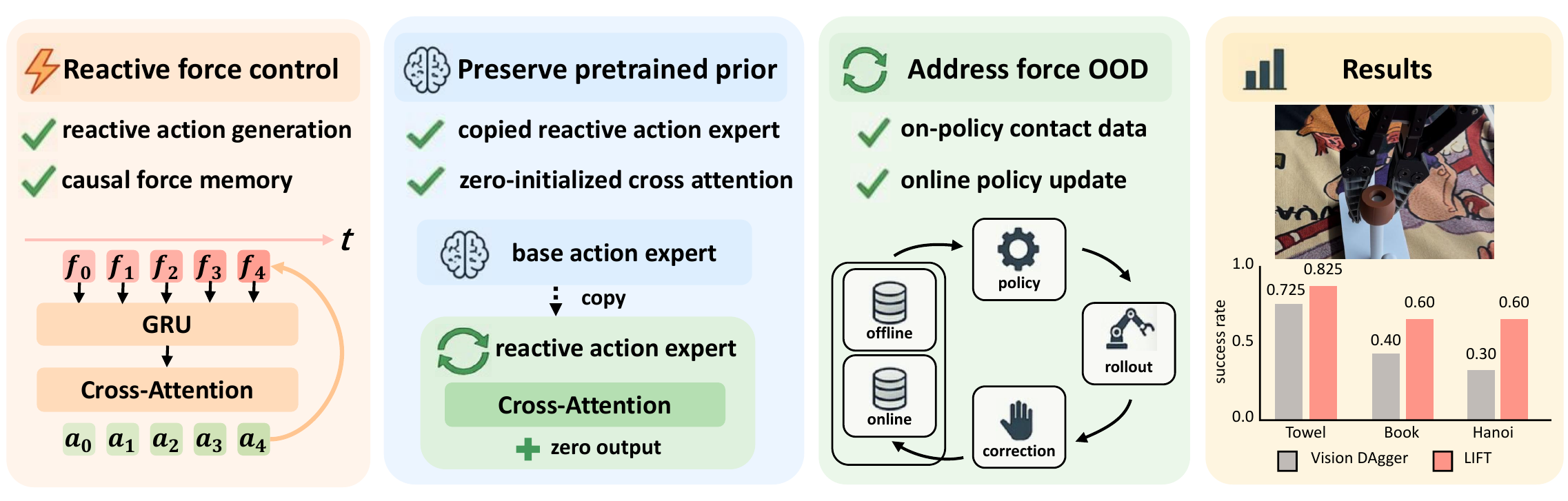
LIFT overview

LIFT grafts a reactive force pathway onto a pretrained VLA, keeps the original visual-language prior intact, and learns from online force corrections collected on the policy's own failure states.

Abstract

Pretrained vision-language-action policies carry strong language-conditioned manipulation priors, but they remain largely vision-driven. In contact-rich states, visual observations can be ambiguous: occlusion, partial observation, and depth error make it hard to know whether the robot has actually grasped, inserted, or seated an object.

LIFT (Late Reactive Injection of Force for VLA Post-Training) adds force after pretraining instead of rebuilding the foundation model. It encodes recent 6D end-effector force as causal force memory, injects it through zero-initialized cross attention, and trains a reactive action expert beside the original VLA action stream.

Across towel folding, book insertion, and Hanoi ring placement, LIFT learns faster and reaches stronger performance than vision-only post-training while preserving the pretrained VLA prior.

Method

Reactive Force Injection

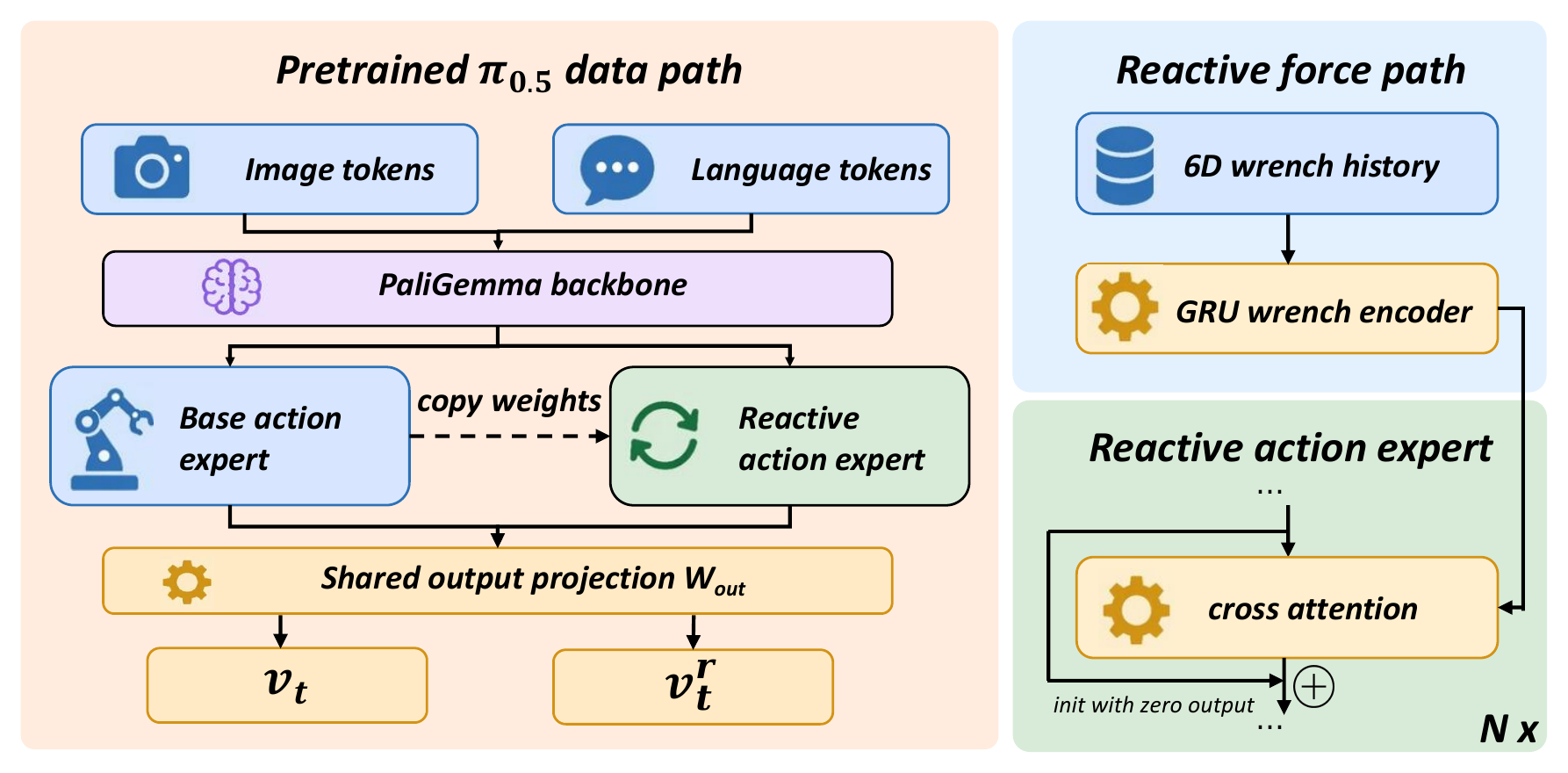
LIFT starts from a pretrained vision-only VLA and grafts a reactive action expert beside the original action expert. Instead of committing to a full open-loop action chunk, the reactive stream decodes actions causally within the chunk and receives recent 6D end-effector force as latency-aligned force memory.

At runtime, the slow vision-language prefix is computed once and cached. Each within-chunk refresh only re-encodes the newest force window and reruns the lightweight reactive branch, allowing the policy to respond to contact changes without a full vision-language forward pass.

LIFT architecture
LIFT architecture. Recent force is encoded as causal memory and injected into the reactive branch.

Prior-Preserving Initialization

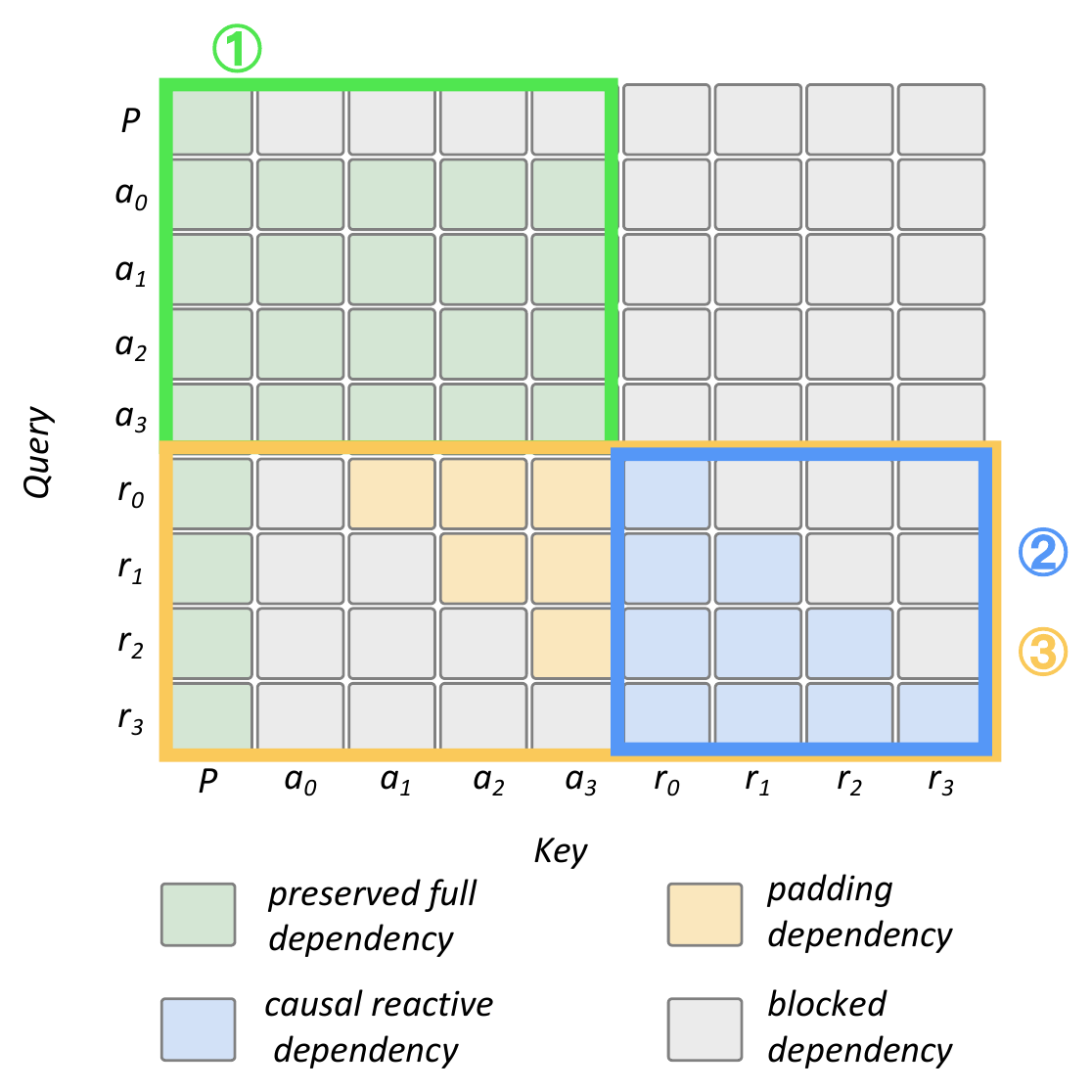
Shifted causal attention mask
Shifted causal attention. Initialization-equivalent action decoding.

Adding a force pathway should not erase the pretrained VLA prior. LIFT copies the original action-expert weights into the reactive expert and uses a shifted causal attention pattern so each reactive token receives an equivalent context to the original fully attentive action token at initialization.

The force-injected cross attention is added as a residual update with a zero-initialized output projection. Before post-training, the force residual is exactly zero, so the augmented model starts from the same action output as the base VLA.

Training with Heterogeneous Data

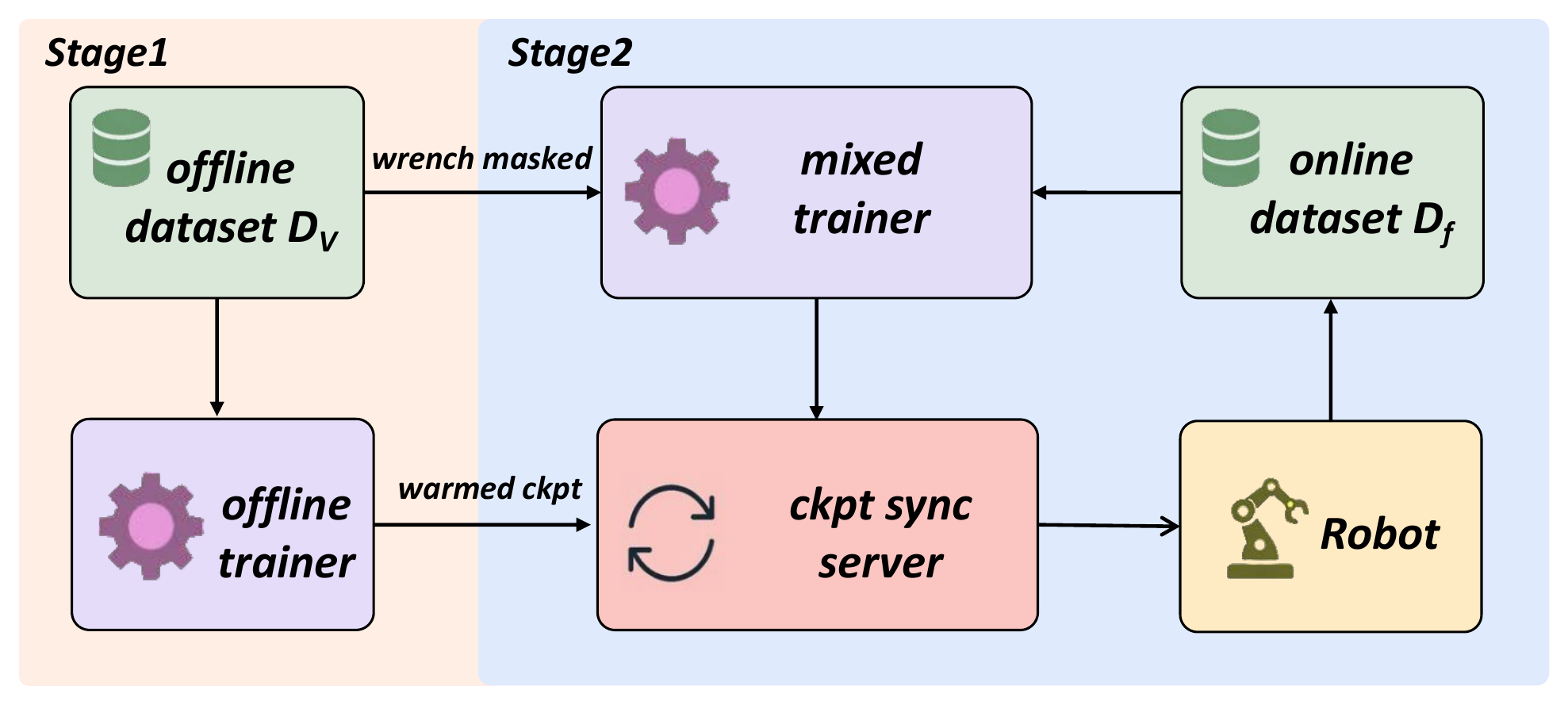
LIFT trains one model on both abundant vision-only task-alignment data and scarce force-enabled online corrections. Vision-only batches use zero force placeholders and mask the encoded force memory, while online correction batches keep measured force active.

The post-training loop mixes offline visual data with online DAgger corrections. This lets the policy preserve broad task knowledge while learning force responses from states visited by the current policy.

LIFT training pipeline
Training pipeline. Vision-only alignment followed by online force-correction post-training.

Experiments

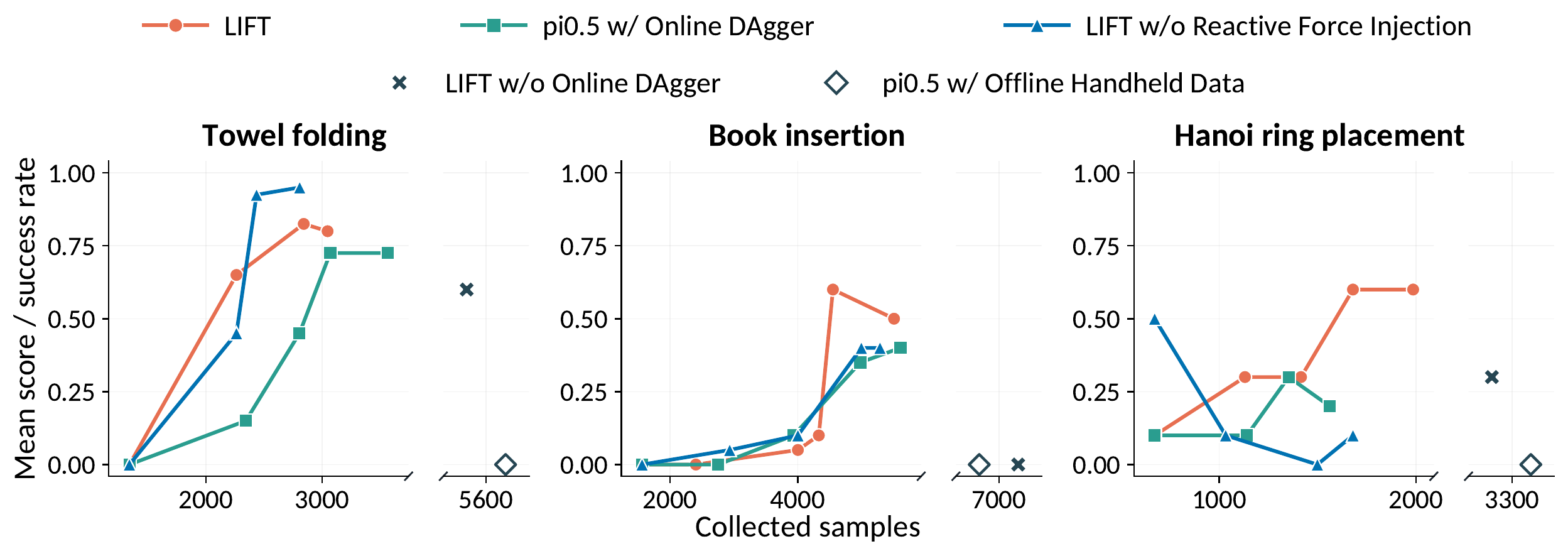
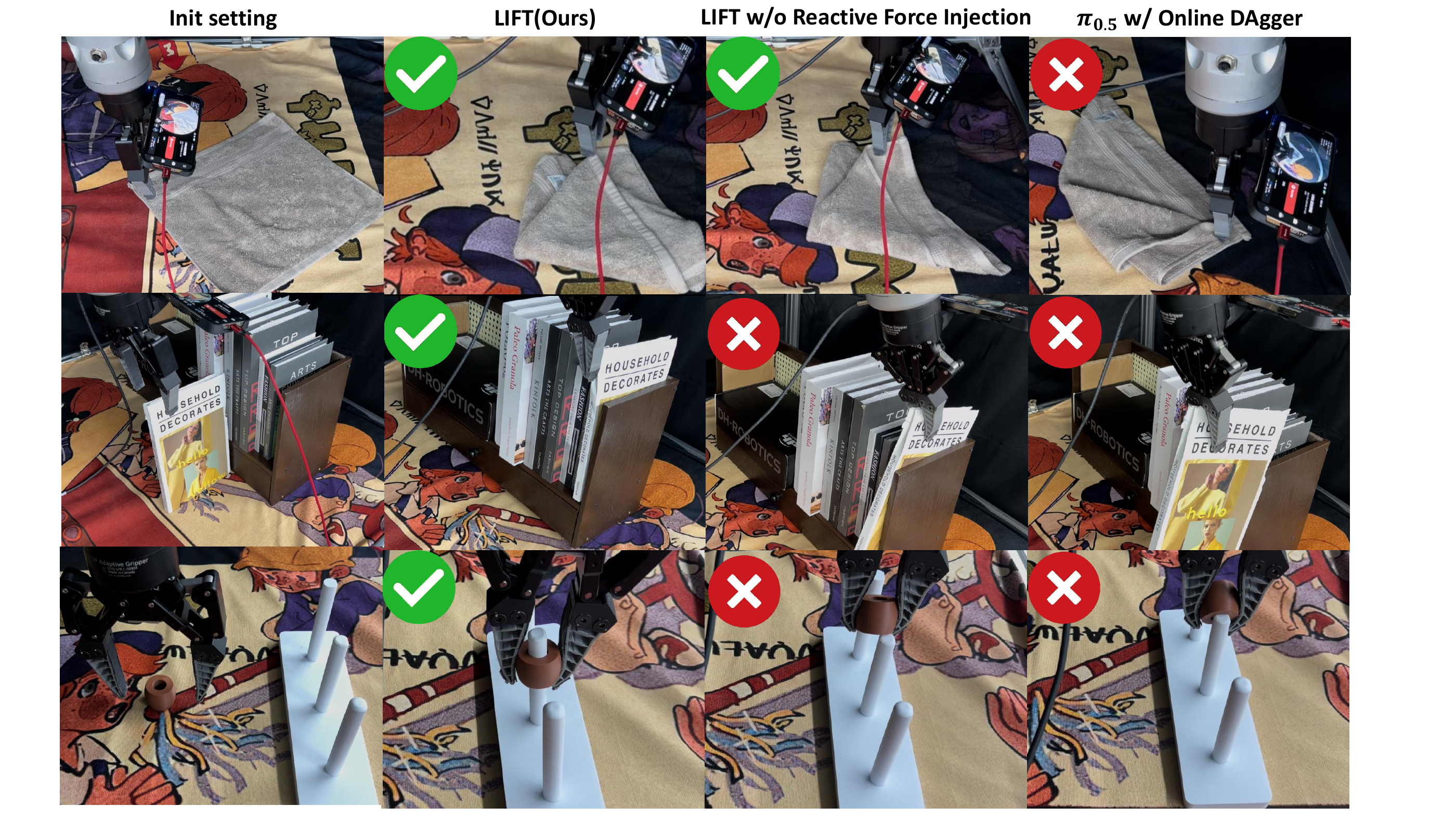
We evaluate LIFT on three real-robot contact-rich tasks: towel folding, book insertion, and Hanoi ring placement. The comparison includes LIFT, the full reactive force-injection system; LIFT w/o Reactive Force Injection, which uses force without the reactive force-memory pathway; LIFT w/o Online DAgger, which removes repeated on-policy corrective updates; and π0.5 w/ Online DAgger, a vision-only online post-training baseline.

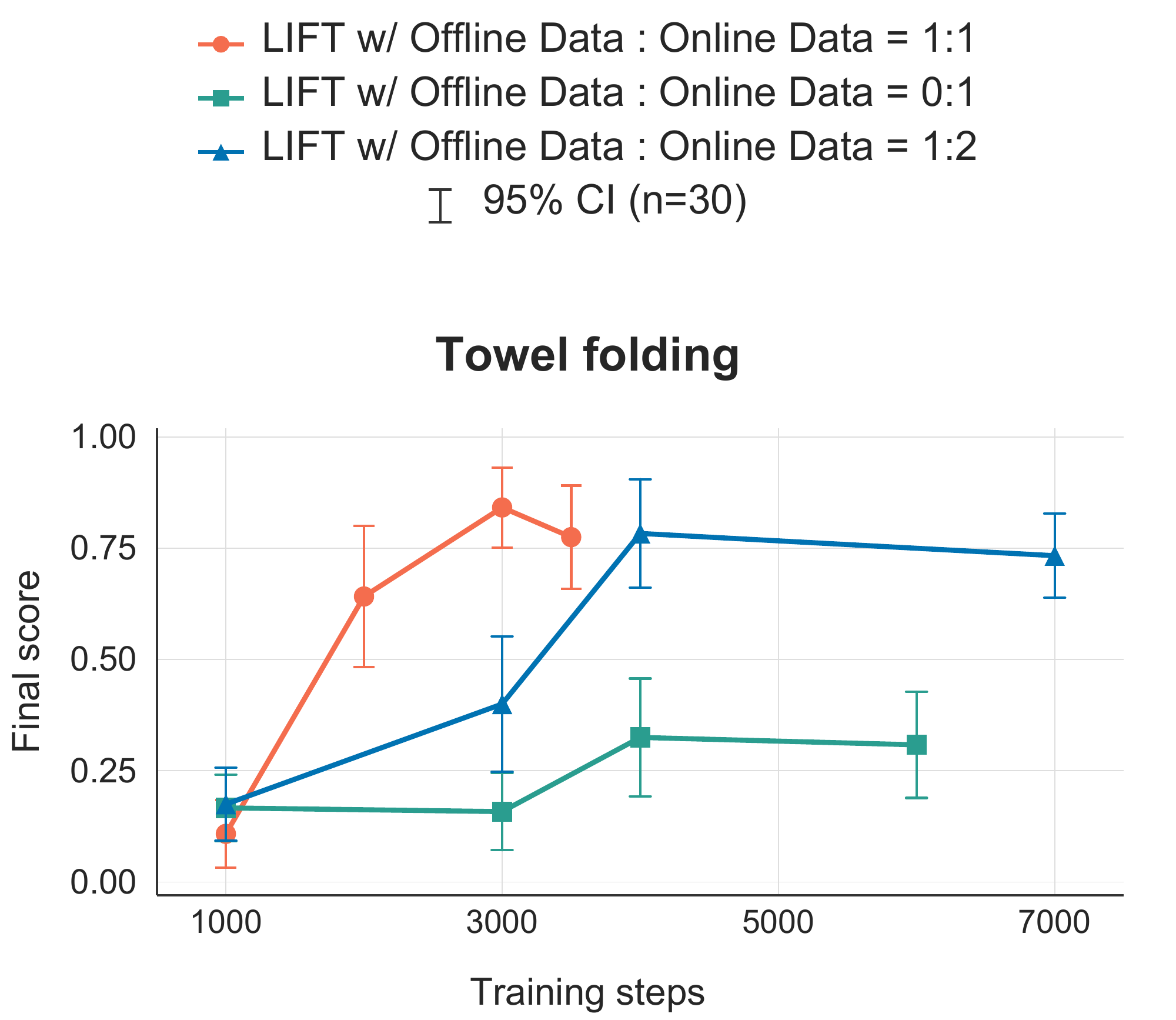
Online learning curves for LIFT
Performance curves. LIFT and its ablations are compared against the vision-only online DAgger baseline across the three manipulation tasks.

Videos

Towel Folding

LIFT

LIFT

π0.5 w/ Online DAgger

π0.5 w/ Online DAgger

Book Insertion

LIFT

LIFT

π0.5 w/ Online DAgger

π0.5 w/ Online DAgger

LIFT w/o Reactive Force Injection

LIFT w/o Reactive Force Injection

Hanoi Ring Placement

LIFT

LIFT

π0.5 w/ Online DAgger

π0.5 w/ Online DAgger

LIFT w/o Reactive Force Injection

LIFT w/o Reactive Force Injection

Q1: Does force accelerate VLA post-training?

This question compares LIFT and LIFT w/o Reactive Force Injection against π0.5 w/ Online DAgger. The result shows that force-aware post-training learns faster and reaches stronger task performance than vision-only online post-training.

Q2: Does reactive force injection matter?

This question compares LIFT with LIFT w/o Reactive Force Injection. The result shows that recent force memory and within-chunk reactive updates are important for contact phases that cannot be resolved from a single force frame.

Q3: Does online data matter for reactive force injection?

This question compares LIFT with LIFT w/o Online DAgger. The result shows that offline force data alone misses many contact states encountered by the learner, while online DAgger collects corrections on the policy's own failure states.

Q4: Does LIFT preserve generalization?

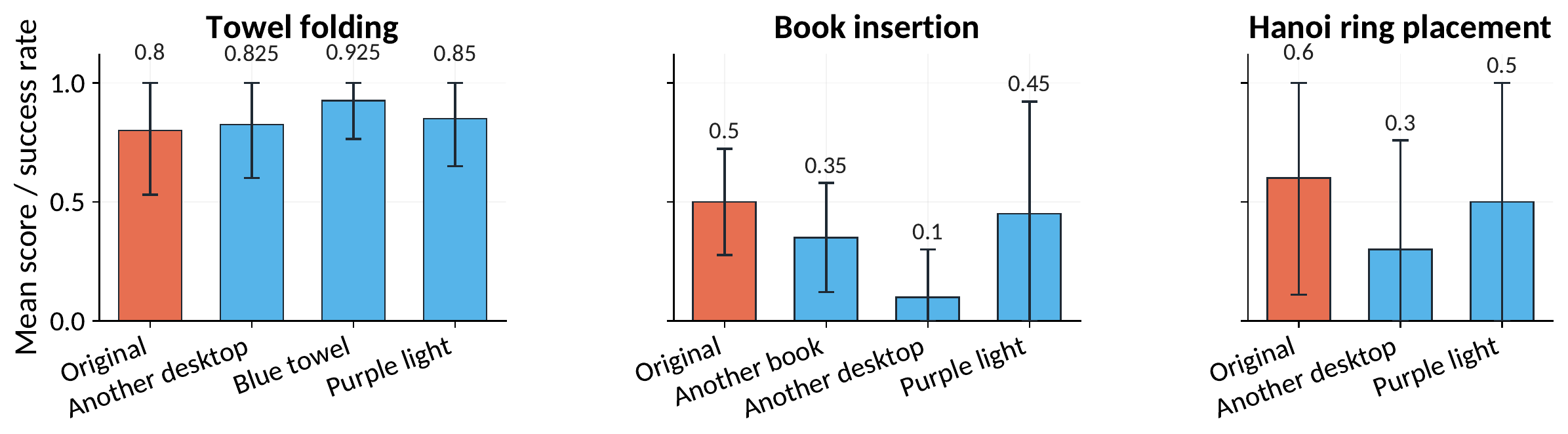
This question evaluates the final LIFT checkpoint under object, tablecloth, and lighting shifts. The result shows that LIFT keeps the visual generalization inherited from the pretrained VLA while adding force-aware contact adaptation.

Generalization performance bars
Generalization results. Performance under shifted task conditions.
Generalization task settings
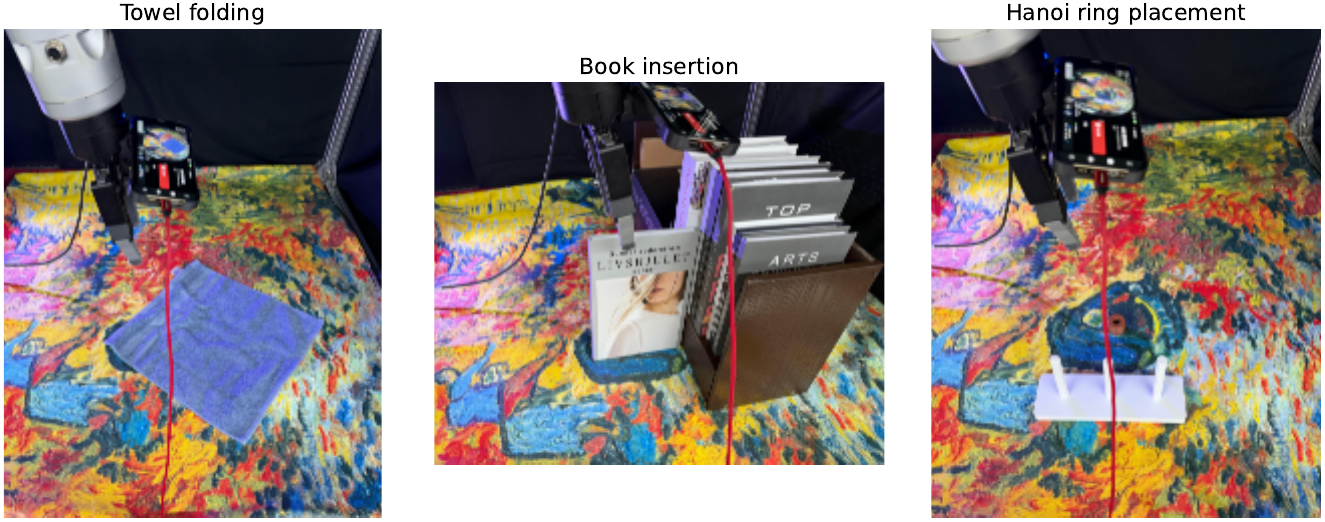
Generalization settings. Task setups used for shifted-condition evaluation.

BibTeX

@article{wang2026lift,
  title   = {LIFT: Never Too Late for Force -- Accelerating VLA Post-Training with Reactive Force Injection},
  author  = {Wang, Yi and Chen, Wendi and Wen, Zimo and Xue, Han and Li, Xueqi and Yu, Wenye and Chen, Zhijie and Yang, Hao and Lv, Jun and Wen, Chuan and Lu, Cewu},
  journal = {arXiv preprint arXiv:2607.14236},
  year    = {2026}
}